
Transport
Nationwide collection
Every building we buy has to be lifted, loaded and driven away. We do that ourselves, on our own vehicles, which is why we can give you a date instead of a window.
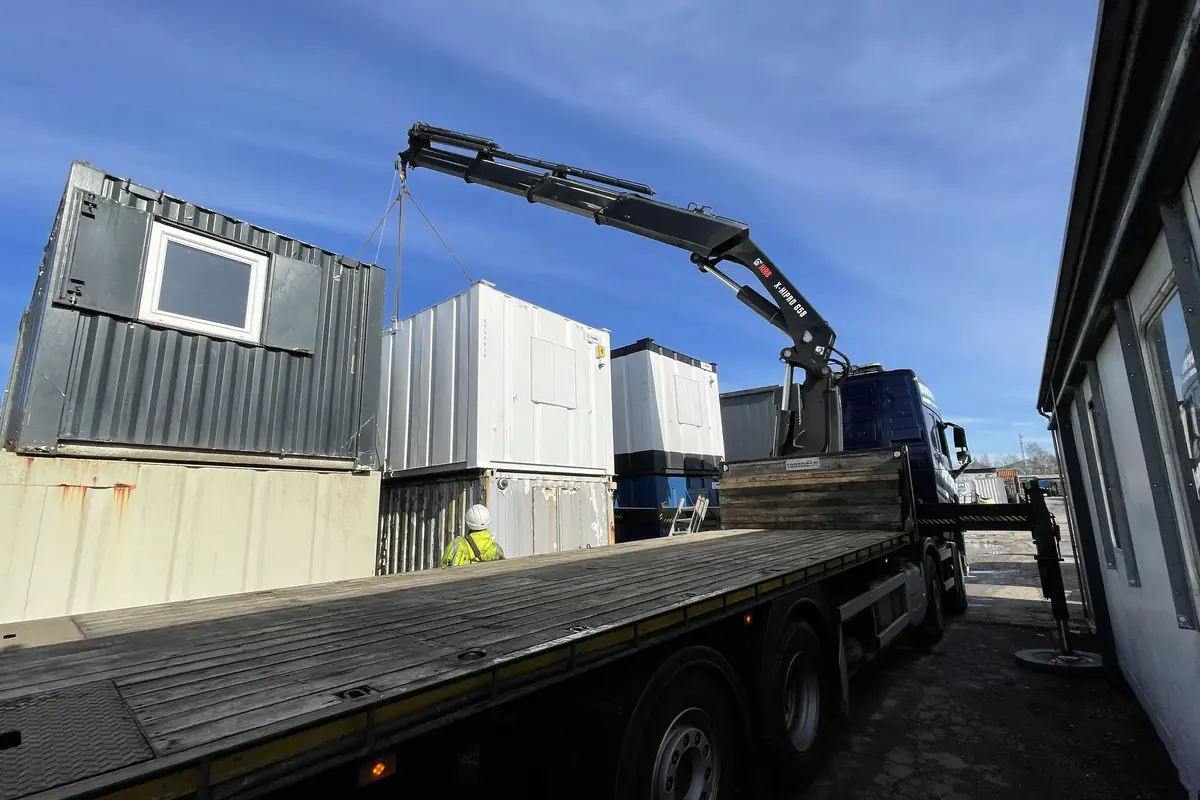
Owning the fleet changes what we can promise
Most of the frustration in this trade comes from dates that were never really dates. A firm that subcontracts its haulage cannot commit your collection to a day, because the vehicle belongs to someone else and someone else decides what it does on Tuesday.
We run our own transport. When we say a building is coming out on a particular day, we are allocating our own vehicle and our own driver, and the consequence of getting it wrong lands on us. That is the whole reason the arrangement exists.
It also means the person who quoted the job and the person who arrives to do it are working from the same information. There is no handover where the access notes get lost.
The lift
How a building comes off its base
The physics is unforgiving and does not care how the day is going. Three things decide whether a lift happens: where the building can be picked from, where the vehicle can stand, and what it can stand on.
- Designed lifting points
- Chassis lifting eyes, corner castings or reinforced frame points, used because that is where the structure was built to carry its own weight. We do not improvise slinging arrangements and we do not lift from anywhere the building was not designed for.
- Reach, not proximity
- The vehicle lifts from a fixed standing position. Distance from that position to the building is what limits the job, so a unit deep in a yard behind other buildings is a different proposition to one beside the gate.
- Ground bearing
- Outriggers put a great deal of load through a small footprint. The standing area has to be firm and reasonably level. Made ground, soft verges, backfilled trenches and anything over a void need flagging in advance.
- Overhead clearance
- Nothing is lifted under a live overhead line, and low branches, canopies and lighting columns limit where the lift can happen. Photographs taken looking upwards are more useful than most people expect.
- Route in and out
- Width at the narrowest fixed point, height at the lowest obstruction, and the turning circle at the tightest bend. A loaded vehicle is bigger than an empty one in every dimension.
- Building condition
- Corroded chassis, rotten floors and previous badly executed lifts all affect whether a unit will survive being picked up. Sometimes the honest answer is that it cannot be moved whole.
Collection day
What helps and what stops it
Have this ready
- Services isolated and disconnected. Power, water, gas, drainage and data all dead, arranged by you beforehand.
- The building empty. Furniture, racking, files, tools and personal items out. We lift buildings, not contents.
- Keys or an open building. Locked units that nobody can open waste the visit for everyone.
- Someone with authority on site. Able to confirm the unit is dead, answer questions and sign the collection off.
- The standing area clear. Vehicles, plant, pallets and skips moved off the spot the lorry needs.
- Site rules known in advance. Induction requirements, permit systems, banksman arrangements and access times told to us when the date is booked, not on arrival.
What stops a lift
- Live services. The most common single reason a booked collection is aborted, and entirely avoidable.
- Overhead cables above the lift. No load goes up under a live line, regardless of what was planned.
- Ground that will not take outriggers. Soft, waterlogged or unknown ground means the vehicle cannot set up safely.
- Access narrower or lower than described. A gateway measured optimistically ends the job at the entrance.
- No sound lifting point. A corroded chassis or a missing lifting eye means the building cannot be picked as it stands.
- A building still full. Loose contents shift in transit and change the weight distribution, so it does not travel.
If any of these apply and you tell us beforehand, most of them can be designed around. Told on the day, they simply cost everybody a wasted visit. Send the awkward photograph rather than the flattering one.
Where we go
England, Scotland and Wales
From a Manchester base, with distance affecting the cost of a move rather than whether it happens. We do not cover the Isle of Man or the Channel Islands.
Areas covered
Region by region, honestly, including where distance starts to matter and where a job becomes case by case.
See the coverage →Removal
What happens when the building is being taken away rather than bought, and what we need before quoting.
How removal works →Selling to us
The route most collections start from. Photographs, a postcode and an honest word about condition.
Start a sale →Common questions
Collection, asked and answered
Why does it matter that you own the transport?
Because a date is only worth what the person giving it controls. Subcontracted haulage means your collection sits in somebody else's diary and can be moved when a better-paying load appears. We run our own vehicles, so when we commit to a day we are committing our own resource rather than passing on an estimate.
What is a designed lifting point?
The place the manufacturer built the unit to be picked up from, usually chassis lifting eyes, corner castings or reinforced points in the frame. Lifting anywhere else risks racking the structure, pulling the frame out of square or dropping the load. If a building has no sound lifting point, we cannot collect it as it stands.
How close does the lorry need to get?
Within reach, which is not the same as within sight. The vehicle lifts and places from a fixed standing position, so the distance from that position to the building is the limiting factor. A building fifteen metres into a yard with no hardstanding between is a very different job to one beside the gate.
What ground do the outriggers need?
Firm, reasonably level ground that will take a concentrated load. Hardstanding, tarmac or well-compacted stone is ideal. Grass, made ground, recently backfilled trenches, soft verges and anything over a cellar, tank or suspended slab all need mentioning beforehand so the standing position can be planned.
Do I need to be on site when you collect?
Somebody with authority to open up, confirm the building is dead and sign for the collection should be there. It does not need to be the person who arranged it, but it does need to be somebody who can answer questions. Sites where nobody can be reached are where collections get aborted.
How far will you travel for one building?
Anywhere in England, Scotland and Wales. Distance affects what a move costs rather than whether we will do it, and a single unit a long way out is still worth an enquiry. Our lorries are out across the country most weeks, so a building that sits near a route we are already running can often be collected as a back load on the return leg, which is the cheapest way for a single unit to move. Where several buildings can be collected on one run, the economics improve again.
Book a collection you can plan around
Send us the postcode and a photograph and we will tell you what we can commit to. Anything else we need, we will ask.