
Greater Manchester · Merseyside · Cheshire · Lancashire · Cumbria
Portable buildings North West
This is our own region. Buildings and containers bought, removed, cleared and supplied right across the North West, on vehicles we own, from a yard in Manchester rather than an address on a website.
Selling or clearing
The short run is where selling makes most sense
Transport is the part of the figure that distance moves. Everywhere else in England, Scotland and Wales the haulage has to be planned and paid for; here it is a short run on a vehicle that is already out. That is why a building standing in Wigan or Widnes is worth putting in front of us even when it is a single unit.
The same applies in reverse to clearing. A compound that has to be empty by a date is a straightforward job to sequence when the yard is forty minutes away, and units can go out in the order the site needs rather than the order the haulier can manage.
- What we buy
- Portable offices, welfare and messing units, modular blocks, stores, drying rooms and containers.
- How many
- One building, a handful, or a full compound cleared in a planned sequence.
- What we need first
- Photographs, rough dimensions, the postcode and an honest word about condition.
- Payment
- Bank transfer on collection, unless something else is agreed in writing beforehand.
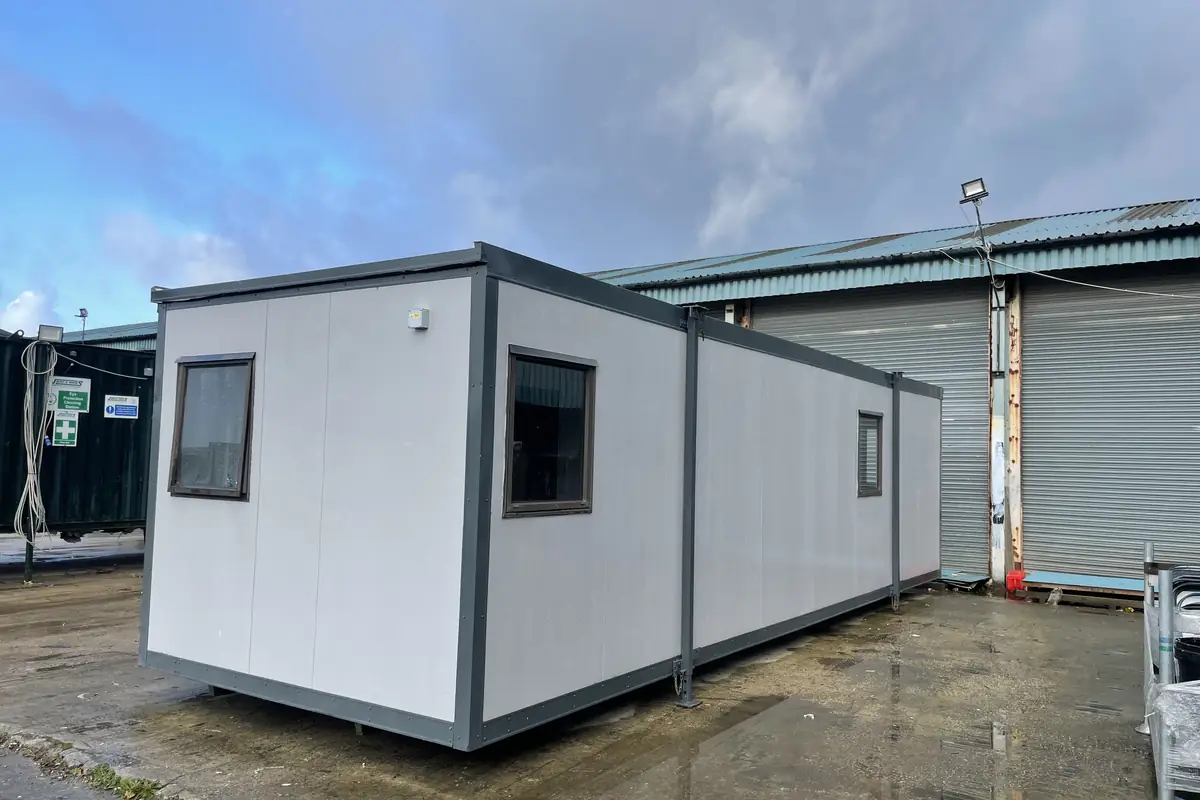
Coverage
The counties, and the towns inside them
Nowhere on this list is treated as an outlying job. It is all inside the working day, and none of it needs a separate haulier.
- Greater Manchester
- Manchester, Salford, Bolton, Bury, Oldham, Rochdale, Stockport, Tameside, Trafford and Wigan. Our own doorstep, and the area with the heaviest concentration of construction compounds and logistics sites. Modular buildings Manchester covers the city itself in more detail.
- Merseyside
- Liverpool, Birkenhead and the Wirral, St Helens, Southport, Bootle and Huyton. Dock and port work, regeneration schemes and a steady flow of site accommodation coming off finished contracts.
- Cheshire
- Warrington, Chester, Crewe, Macclesfield, Northwich, Runcorn, Widnes, Ellesmere Port and Congleton. Chemical and manufacturing plants, distribution parks and a large rural fringe where units stand for years on farms and yards.
- Lancashire
- Preston, Blackburn, Burnley, Blackpool, Lancaster, Chorley, Accrington, Leyland, Skelmersdale and Morecambe. Housing schemes, highways work and a strong education estate that turns over teaching accommodation regularly.
- Cumbria
- Carlisle, Barrow-in-Furness, Kendal, Workington, Whitehaven, Penrith and Ulverston. Longer runs than the rest of the region, largely industrial and agricultural, and best handled with more than one unit moving at a time.
We do not publish response times for any of these places, because the honest answer depends on where the vehicles are that week. What we will do is tell you the date when you enquire rather than after you have committed.
Where the work comes from
What generates buildings in this part of the country
Construction and infrastructure
Housing, commercial development, highways and rail. Compounds are set up, run for the duration and then have to be clear by a fixed date. That deadline is where most contractor stock reaches us.
Logistics and industry
Distribution parks, chemical and manufacturing sites across Cheshire and the Mersey corridor. Site offices, gatehouses, stores and containers that outlast the project that justified them.
Education
Schools, academy trusts and colleges across all five counties. Temporary teaching accommodation goes in for a rebuild and becomes a standing cost once the permanent block opens.
Healthcare and public estates
NHS trusts and local authorities running decants and capital programmes. Units are often well maintained and reach the end of their purpose on a timetable rather than because of condition.
Farms and rural yards
Ex-site offices, welfare units and containers bought years ago for one job and left standing since. Condition varies enormously, so every one comes down to photographs.
Fleet operators
Fleet operators rotating stock out. Usually sound, usually in numbers, and usually needing to move on a date that suits them rather than us.
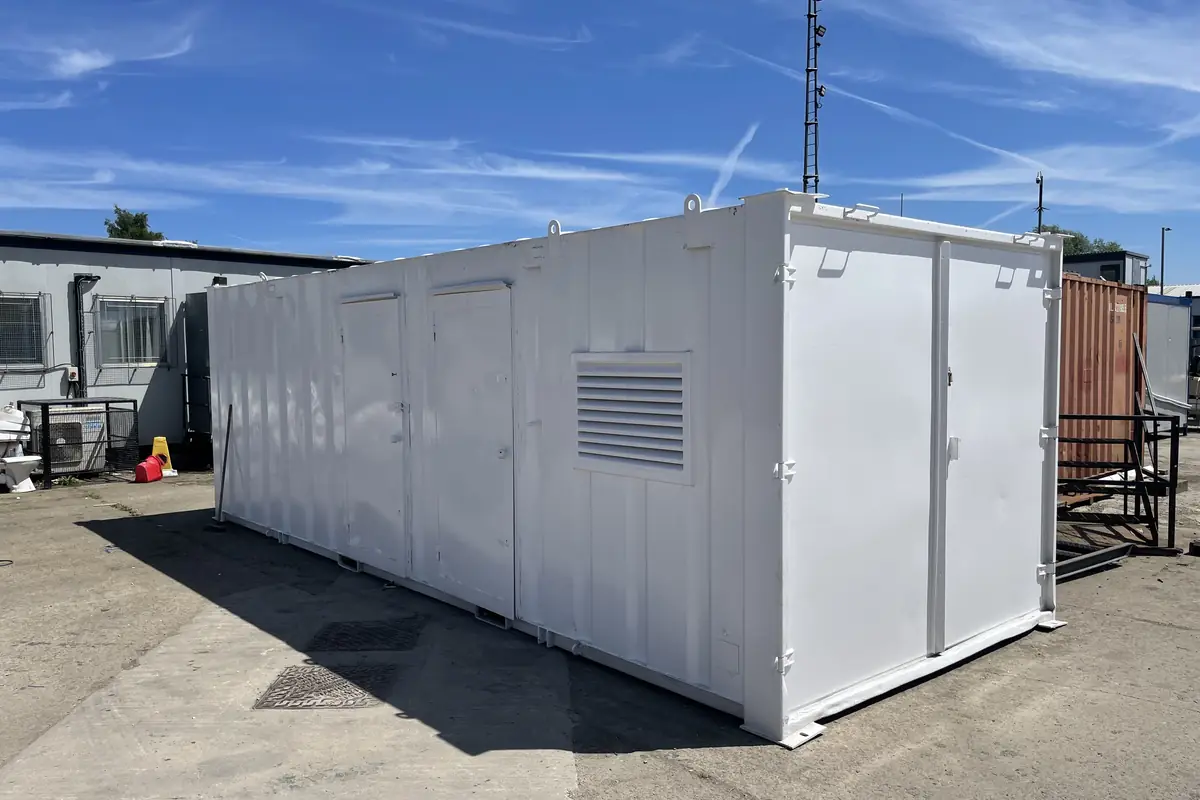
Buying in the North West
It works the same way round. Tell us the size, the layout and roughly what you want to spend, and we will tell you what we can supply, what condition it is in and what the building and the haulage each cost as two separate figures.
Being in the region helps here too. A short delivery is a cheap delivery, and a building can normally be looked at in the yard before it goes anywhere. Refurbishment — new flooring, a repaint, replacement windows, a revised partition layout — is far easier to do while it is still standing with us than after it has landed on your site.
Local questions
The North West, asked and answered
Where in the North West do you actually cover?
Greater Manchester, Merseyside, Cheshire, Lancashire and Cumbria. That is the whole region rather than a radius drawn round the yard, and it is the part of the country we can reach and get back from inside a working day.
Is the North West cheaper to work in than the rest of the country?
For transport, yes, and it is the one part of the quote where being local shows. The building is worth what it is worth wherever it stands. Moving it from Bolton or Warrington costs less than moving it from Cornwall, and on a short run several units often travel on the same vehicle.
Do you have your own yard in the region?
Yes. We are based in Manchester and the vehicles run from there, which is why the region is covered on our own transport rather than through subcontracted haulage. It also means a collection date is one we set rather than one we are waiting on somebody else for.
Who do you buy from around here?
Contractors clearing compounds, fleet operators rotating their stock, schools and academy trusts, NHS estates, local authorities, industrial units, farms and private individuals. The North West has a heavy concentration of construction, logistics and education estates, which is where most stock comes from.
Can you take a whole compound rather than one unit?
Yes, and it is usually the easier job. A compound can be planned as a sequence with the transport organised around it, whereas a single unit has to justify a trip on its own. Mixed sites are normal: some buildings get bought, some get removed, and they are separated as we work through them.
How do I start if I have something to sell?
Photographs, rough dimensions, the postcode it is standing on and an honest word about condition. That is enough for a first answer. If it is sound we will tell you what it is worth to us; if it is finished we will say so and quote to clear it instead.
Buying, selling or clearing in the North West
Send what you have, or what you need, with the postcode. This is the region we work in every week, so the answer comes back quickly and the transport line is the smallest it gets.