
Second hand portable buildings for sale
The most common thing we are asked for, and the most useful place to start. Second hand, 2nd hand, secondhand, used, pre-owned, ex-hire and refurbished all mean the same thing here. So do “second hand cabins”, “used portable cabins” and “portable cabins for sale” — those are simply the words people reach for when the unit is a single bay rather than a multi-bay block. Whether you are after one portable building for sale or a run of used portable buildings for sale, tell us the size, the layout and the postcode, and we will tell you what we can supply, what condition it is genuinely in, and what the unit and the haulage each cost.
What the term covers
One unit, built in a factory, moved whole
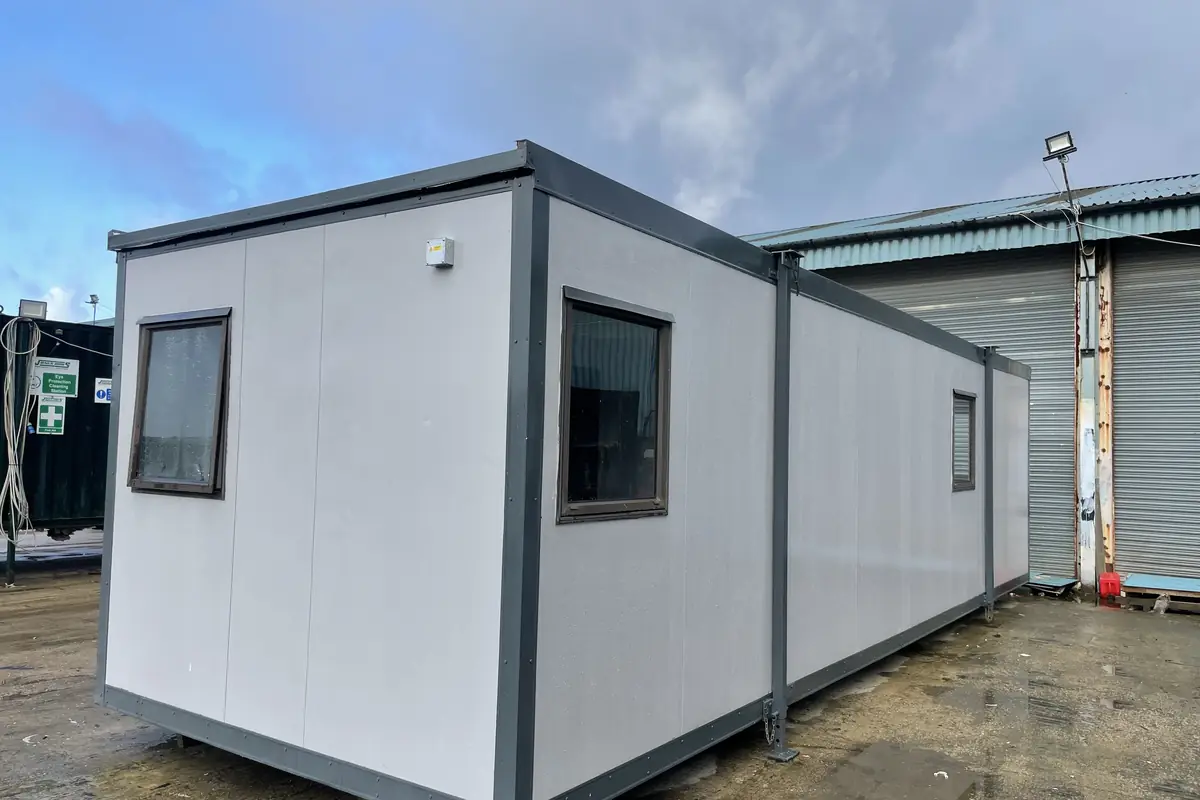
A portable building is a self-contained unit with its own frame, floor, roof and fit-out, made under cover and then transported complete to wherever it is wanted. Site offices, welfare and drying rooms, canteens, stores, changing rooms, gatehouses and small classrooms are all the same animal wearing different fit-outs.
Because it travels as one piece, its width is limited by the road rather than the design. That is the practical difference between this and a modular building, which is delivered in bays and joined on site to make something wider than a lorry could ever carry.
It is also why portable units are the easiest thing to buy used. They were designed from the start to be lifted, moved and used again, so a sound one that has already been relocated three times is not automatically a worse buy than one that has never left its original yard.
Single or linked
Deciding how much building you need
Most people arrive asking for one unit and leave with a clearer idea of whether one is enough. The arithmetic is usually about how the space gets used rather than raw floor area.
- Single unit
- One space, one delivery, one lift. Simplest to buy, simplest to move again later. Suits a site office, a store, a gatehouse or a small team. The ceiling on this option is the legal transport width, not your budget.
- Two units linked
- Set side by side with the adjoining walls opened up, or kept separate with an internal door between. Doubles usable width without the groundworks a modular block needs. The linking detail matters — a poorly sealed joint leaks for the rest of its life.
- Units around a corridor
- Three or more arranged in a run or an L with a covered walkway. Common on construction compounds, where offices, welfare and drying rooms want separating for noise and dirt rather than joining into one space.
- Stacked
- Two levels with an external stair. Useful where the plot is tight. Needs a base designed for the loading and a stair that suits the use, and it is a decision to take before delivery rather than after.
If your need is short-lived rather than permanent, it is worth reading used temporary buildings before you commit, because buying and reselling sometimes beats hiring outright.
Refurbishment
We describe the building, not a grade
Nobody governs what A grade or good used condition means, so the letter tells you very little. We ignore it and talk about the actual unit instead, and about how it will be finished before it reaches you.
What refurbishment covers
- Refurbished throughout. The work is carried out in our own yard rather than put out to somebody else, which is why it is far cheaper done before delivery than after the cabin has landed on your site.
- Painted in the colour of your choice. Tell us the colour when you order and the unit is finished in it before it goes out.
- New heating fitted. The majority of refurbished cabins leave the yard with new heating.
- Electrical certification. Supplied with the cabin, tested and certified here before it goes on a lorry.
What you see before you pay
We always send photographs of your completed refurbished cabin before it goes out, and payment is made before delivery. Nothing leaves the yard without you having seen the building you are getting.
You are also welcome to come and view your completed refurbished cabin at the yard. Viewings are by arrangement at the yard the cabin is standing in, and we would rather you came and looked, particularly on anything where the fit-out is the bulk of the value.
If the layout or the finish needs changing for the way you intend to use it, say so at the enquiry stage and it gets priced properly rather than becoming a job on your site.
Condition is also what decides whether we buy a unit in the first place. What we accept and what we turn down is set out on the what we take page.
Buying used
How the price breaks down, and why used stock is worth the trouble
A price for the cabin on its own is a quote for something standing still. Everything that gets it to you — the lorry, the HIAB, the escort if it is wide, the time on site — is a separate cost, and it is entirely normal for it to change the ranking of two quotes you thought you understood. So we quote both: what the building costs, and what it costs to get it to your postcode. Ask any supplier for the same breakdown before you compare.
The case for buying used rather than new is straightforward. A factory-built unit takes its heaviest depreciation early, but its useful life is measured in decades if the roof and base are looked after. Buying at the second or third owner stage means someone else absorbed the drop while you get the same steel, the same floor deck and, after refurbishment, a fit-out that is new anyway.
What decides the choice is what has come off finished contracts and into the yard, so tell us when you need it standing as well as what you need. We would rather tell you plainly what is available for that date than book something in and disappoint you later.
Trading one in? If you have a unit to move on as part of the deal, say so at the start. A cabin coming the other way generally improves the arithmetic in both directions, and we can quote a building valuation at the same time as your requirement.
Used cabins
Site cabins, site offices, jackleg, anti-vandal and welfare units — the way in if the word you use is “cabin” rather than “unit”.
See the range →Containers
Used shipping and storage containers, side-opening and double-door units, workshops and lined stores.
Read about containers →Prefab buildings
Prefabricated classrooms, offices and clinics, most of it coming off education and healthcare estates and refurbished in our yard.
Read about prefabs →Temporary buildings
Units wanted for months rather than years, where buying outright and reselling often beats a recurring monthly charge.
Read about temporary units →Modular buildings
Multi-bay blocks delivered in sections and joined on site, for floor areas wider than a single unit can give.
Read about modulars →Selling one instead
We buy from contractors, fleet operators, schools, NHS estates, local authorities, farms and private sellers.
How selling works →What are you looking for?
What is standing in the yard changes from week to week, so the useful conversation starts with what you need rather than with a list. Describe the size, the layout and where it is going, and we will tell you what we can supply, in what condition, and what the building and the transport each cost.
Have something to trade in? Tick the part exchange box. A building coming the other way usually improves the arithmetic in both directions.
- Two figures — the building and the haulage — so you can see what you are paying for
- Refurbishment to your specification before delivery is usually possible
- Part exchange welcome — a building coming the other way is part of the deal
Common questions
Second hand portable buildings, answered
What counts as a portable building?
Any self-contained unit built in a factory, fitted out there, and moved whole to where it is needed. Site offices, welfare units, drying rooms, canteens, stores, classrooms and gatehouses all sit under the same heading. The defining feature is that it travels as one piece and can be lifted off again later.
Why is there no price list on this page?
Because a used building is priced by its actual condition, its size and where it has to go. Two units of identical dimensions can be worth very different amounts depending on the state of the floor and roof. Publishing a figure that ignores all of that would mislead you rather than help you.
What does condition grading mean?
Less than sellers imply. There is no industry standard behind terms like A grade or good used, so one yard's B grade is another's scrap. We describe the actual building instead, and everything we sell refurbished is finished and painted in the colour of your choice. You get photographs of the completed unit rather than a letter.
How is the price broken down?
As two figures: the building, and the haulage to your postcode. They are quoted separately because they move independently — the same unit costs a different amount to shift forty miles than four hundred, and access, an escort or a difficult lift change the transport side rather than the cabin. Give us the delivery postcode at the start and you will see both numbers rather than one that hides the other.
Can several portable buildings be joined together?
Yes, and it is common. Units can be set side by side and linked, or arranged around a corridor to make a compound. Linking needs the openings cutting and sealing properly, and the services running between units. It is worth deciding before delivery, because doing it on a live site costs more.
How long does a second hand portable building last?
It depends almost entirely on the roof and the base. A unit kept level, drained and dry lasts a great many years. One sitting in standing water on soft ground deteriorates fast. Look after those two things and the rest is maintenance rather than replacement.
Describe the unit you need and where it is going
Size, layout, delivery postcode and roughly when you want it standing. We will come back with what we can supply, and with the unit and the haulage as two separate figures.