
Relocatable and transportable buildings
Every unit we handle can be moved. Only some are built to be moved again and again without loosening at the joints. That difference is worth understanding, because it is the main thing separating two buildings that look identical on a photograph and are priced a long way apart.
The engineering
Built for the journey, not just the destination
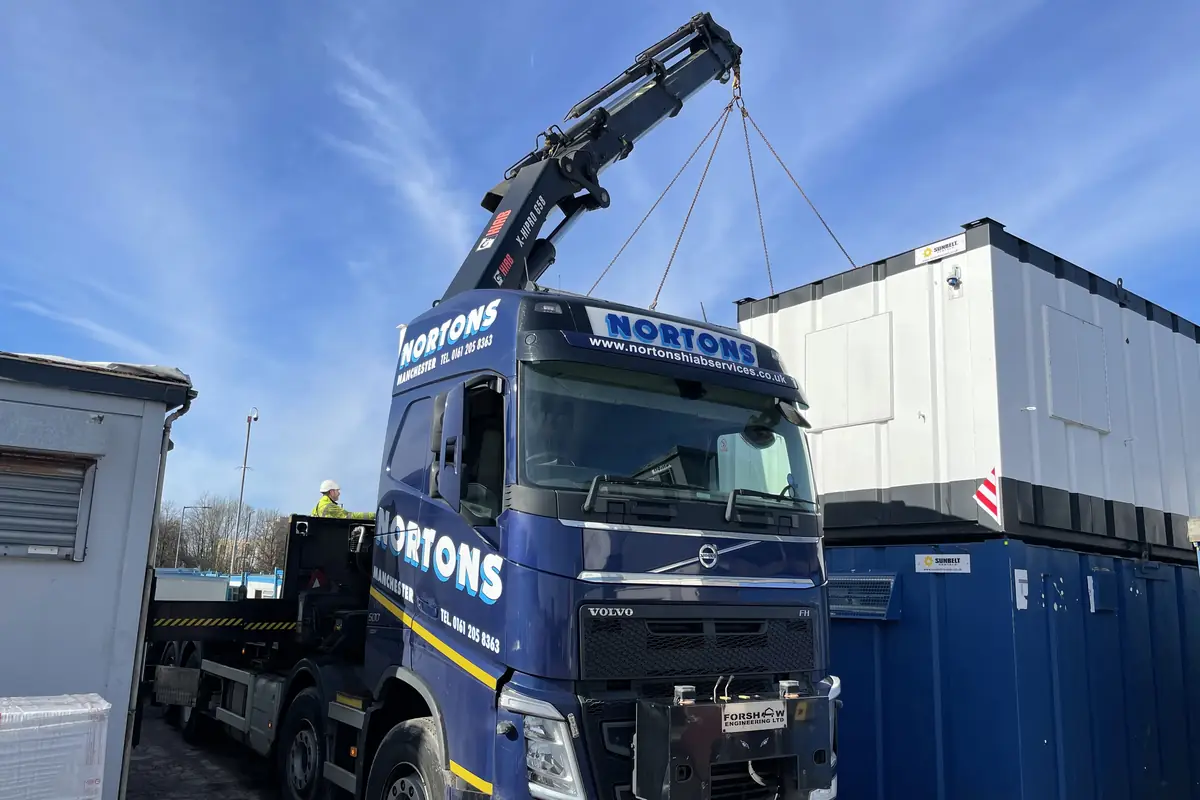
A unit on a lift is not a static structure. It hangs from four points, it twists, and every joint in it takes load in a direction it never sees standing on a base. A building engineered to be relocated is designed around that moment rather than surviving it by luck.
Three things carry most of the difference. The chassis is heavier and continuous, so the floor stays flat when the unit leaves the ground rather than sagging between supports. The lifting points are engineered into the frame and tie back into the main members, instead of being eyes fixed to whatever was convenient. And the connections between frame, wall panels and roof are made to accept a little movement and return to where they started.
Inside, the same thinking shows up in the details. Service runs with a bit of slack in them. Trims fixed rather than clipped. Linings that are screwed back rather than glued. None of it is visible in a listing photograph, and all of it decides whether the unit still shuts its doors properly after the fourth move.
Telling them apart
Moved once, or moved repeatedly
A unit that has made one journey and a unit that has made a dozen wear differently, and the wear is in predictable places. This is what we look at on a viewing, and what you should look at too.
| What to look at | Built and kept for relocation | Built to be sited and left |
|---|---|---|
| Chassis | Continuous, substantial, straight along its length with no local buckling at the support points. | Lighter section, sometimes with corrosion where it has sat on damp bearers for years. |
| Lifting points | Engineered into the frame, undamaged, holes still round rather than pulled oval. | Added later, repaired, plated over, or missing entirely. |
| Corner posts | Square and plumb, no packing plates welded on to take out a twist. | Dented from slings and forks, occasionally out of square by a visible margin. |
| Panel joints | Mastic intact, trims tight, joints consistent along the run. | Cracked sealant, sprung trims, daylight at the head of a joint. |
| Doors and windows | Sitting square, closing and locking without being lifted or leaned on. | Binding, packed out, or adjusted with the hinges wound to their limit. |
None of the right-hand column means a unit is not worth buying. It means the building should be priced as one that will be sited and stay sited, and it should be bought with that in mind.
The arithmetic
When the premium earns its keep
Relocatable stock holds its value because the next buyer inherits the same option you did. That is exactly why it costs more, and exactly why it is sometimes money wasted.
Worth paying more for when
- The unit will follow the work — site to site, season to season, project to project.
- You expect to sell it on within a few years and want the resale market to be wide rather than local.
- Access at either end forces a lift rather than a straightforward set-down from a trailer.
- The unit will be stored between uses and needs to still be square when it comes back out.
- It is going somewhere exposed, where wind loading and repeated handling both work on the same joints.
- Downtime costs you money, and a unit that goes back together quickly is worth the difference.
Not worth paying more for when
- The building is going onto a permanent base and staying there for the rest of its life.
- It is a short-term stopgap you expect to dispose of rather than move on.
- Budget is the binding constraint and a sound, sited unit meets the actual need.
- Access is straightforward at both ends and the lift is a routine one.
- The internal fit-out matters far more to you than the frame, which is often the case with offices.
- You are buying to strip and reuse the space rather than to keep the unit itself intact.
Ask the question at enquiry stage. Tell us whether this building moves again after you have finished with it. It changes what we look for on your behalf, and it frequently changes the sensible budget in one direction or the other by a useful amount.
Related
Where this sits alongside the rest
Containers
Used shipping and storage containers, side-opening and double-door units, workshops and lined stores.
See the range →Temporary buildings
Bought outright for decants, expansions and works. Frequently the use case where relocatable stock pays for itself twice.
See the range →Modular buildings
Multi-bay blocks assembled from factory-built sections. Relocating one is a sequenced operation rather than a single lift.
See the range →Moving something you already own? See collection and delivery and portable building removal. Selling one instead? Start with how we value a unit.
What are you looking for?
What is standing in the yard changes from week to week, so the useful conversation starts with what you need rather than with a list. Describe the size, the layout and where it is going, and we will tell you what we can supply, in what condition, and what the building and the transport each cost.
Have something to trade in? Tick the part exchange box. A building coming the other way usually improves the arithmetic in both directions.
- Two figures — the building and the haulage — so you can see what you are paying for
- Refurbishment to your specification before delivery is usually possible
- Part exchange welcome — a building coming the other way is part of the deal
Common questions
Relocatable and transportable buildings
What makes a building relocatable rather than just movable?
Almost anything can be moved once with enough care. A relocatable building is engineered on the assumption that it will be lifted, transported and set down repeatedly over its life. That shows in the chassis, the lifting points, the way the walls tie into the frame, and in details like service runs that flex rather than fracture when the shell twists on the lift.
How can I tell if a unit has been moved often?
Look at the corners and the lifting points first. Elongated or repaired lifting eyes, distorted corner posts and packing plates welded on later all tell a story. Then look inside at the joints between panels, around door frames and along the ceiling line. Repeated lifting shows up as cracked mastic, sprung trims and doors that no longer sit square in their frames.
Why does relocatable stock hold its value better?
Because the buyer pool for it is wider and the risk of buying it is lower. A unit with a sound chassis and intact lifting points can be moved again by whoever buys it next, so it stays saleable rather than becoming a fixture. Buildings that can only survive one more journey are valued accordingly, because for most buyers they are effectively a one-way purchase.
Is it always worth paying more for a relocatable building?
No. If the unit is going onto a base and staying there for its remaining life, the extra engineering is money spent on something you will never use. The premium earns its keep when the building follows the work, when it will be sold on afterwards, or when access at one end or the other means it has to be lifted in and out.
Can you move a unit I already own to a new site?
Yes. We run our own transport rather than subcontracting haulage, which means the date is one we control. What we need first is photographs, dimensions, the postcode at both ends and an honest account of access at each. Overhead cables, soft ground, gateway widths and turning space decide the method more often than the unit itself does.
What is a transportable building?
In everyday use it means much the same as relocatable, though it tends to emphasise the journey rather than the repetition. People also use it for buildings sized deliberately to travel on a standard trailer without special measures. We treat the terms as interchangeable and simply describe what a given building is built to withstand.
Tell us whether it moves again
It changes what we look for and what you should sensibly spend. Send the size, the layout you need, both postcodes if it is a relocation, and how access looks at each end.