
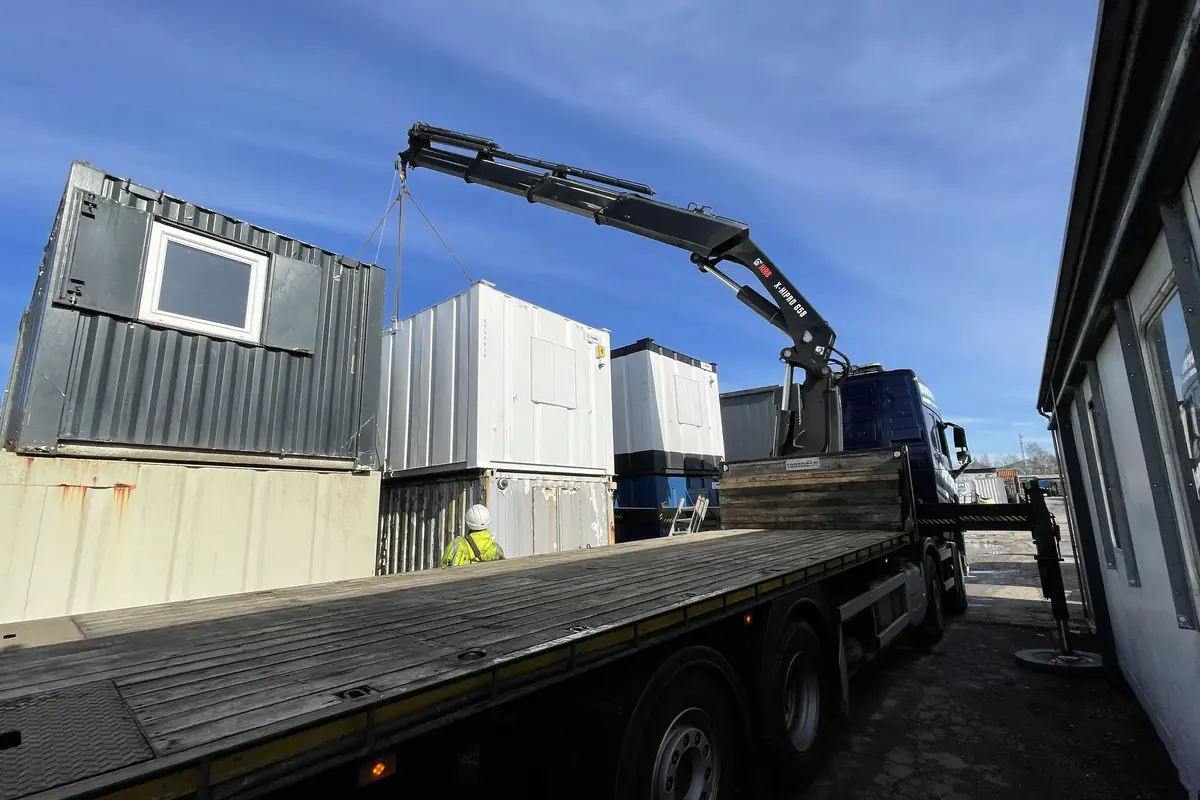
The lift itself is the easy part. What turns a straightforward collection into a wasted journey is nearly always something that should have happened the week before and did not.
None of what follows is complicated. It is simply that it belongs to you rather than to us, and it has to be finished before a vehicle is on its way.
Services have to be disconnected and made safe
This is the big one. Electrical, water, drainage, gas and heating connections all have to be disconnected and made safe by somebody competent to do that work. Our crews do not disconnect live services, and a building that is still connected is not going anywhere.
Two details that catch people out. First, a supply that is switched off at a board is not disconnected. Second, the cable or pipe running to the building often belongs to the site rather than the building, and somebody has to decide whether it is being pulled back, capped or cut. Getting that agreed in advance is worth more than it sounds.
Empty means empty
Everything you intend to keep has to be out. Furniture, files, tools, the kettle, the noticeboard that has been there since before anyone remembers. Anything left behind travels with the building and is not coming back.
Buildings travel better empty for a practical reason too. Loose contents shift on a lift and during transport, and a filing cabinet sliding down a unit as it comes off the base does real damage to a floor and occasionally to a wall.
Fixed items are different. Shelving, benching, partition walls and fitted kitchens can normally stay. If something is fixed and you want to keep it, take it off before the day rather than expecting the crew to remove it.
Doors, windows and anything that can swing
Doors locked or strapped, windows shut, roller shutters down and secured, and anything hanging outside the building taken off. A door that swings open mid-lift catches wind and catches people.
If keys exist, they need to be there on the day. A locked building with no key is not a disaster but it is a delay, and if the building is being bought the keys are part of what is being sold.
Clear the lift path and the standing
The vehicle needs somewhere to stand that will carry it loaded, with room for outriggers, and a clear arc between the building and the bed. That means moving cars, skips, pallets, stacked materials and anything else that has accumulated round the unit while it has been standing.
The bit people forget is above head height. Cables, branches, canopies, signage and gantries all sit in the arc, and the driver has to see the whole path.
Ground matters as much as space. Soft, made-up or recently disturbed ground under a loaded vehicle with outriggers down is a real problem, and it is worse in winter. If the standing is questionable, say so when the job is being quoted rather than on the day.
Under the building
Have a look at what the unit is actually sitting on. Blocks, sleepers, pads, a concrete base, jacklegs wound down onto plates, or something improvised years ago that nobody remembers building. Whether the unit can be lifted off cleanly depends on it, and photographs of the corners are genuinely useful.
Anything growing through, up against or over the building wants cutting back too. Established brambles and self-seeded saplings do a surprising amount to slow a lift.
Access, gates and permissions
Gate widths, height restrictions, barriers, locked compounds, a security office that needs notice, a shared yard where somebody else parks across the entrance at seven in the morning: all of it needs to be known and arranged. If the route in crosses land that is not yours, that permission is yours to obtain.
Where a site has induction requirements, permits or a signing-in procedure, tell us at the quoting stage rather than at the barrier.
What sits with us
The lift, the securing of the load, the transport and the paperwork for the move. We work on our own transport rather than subcontracting the haulage, which is why the date is one we control.
Payment for buildings we buy is by bank transfer on collection, unless something different has been agreed in writing beforehand. The figure is settled before the lorry is booked, so there is nothing to negotiate on the day.
The short version
- Services disconnected and made safe by somebody competent.
- Building emptied of everything you are keeping.
- Doors secured, windows shut, keys available.
- Lift path and standing clear, above head height as well as at ground level.
- Vegetation cut back, obstructions moved.
- Gates, permits and permissions sorted.
Do those and the collection is dull, which is exactly what you want it to be. Building removal explains how the rest of it works, and you can send the details whenever you are ready.