
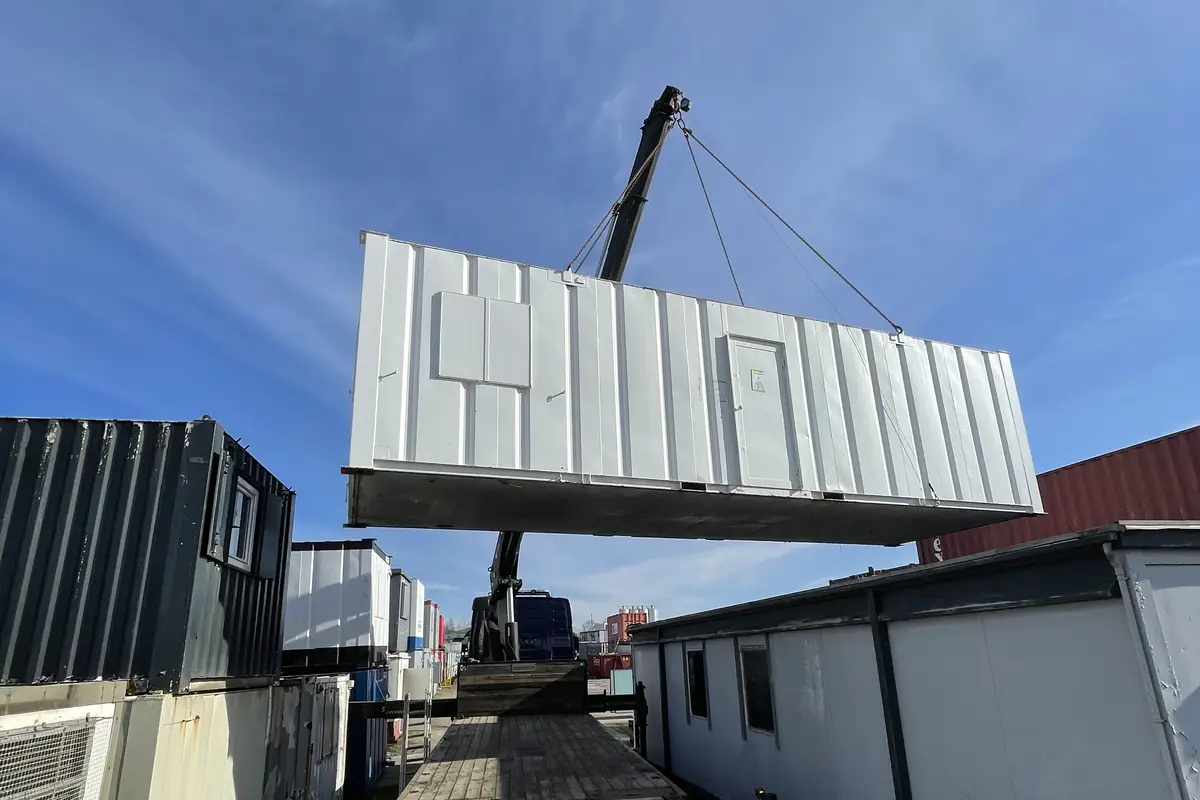
Half the enquiries we take use the words removal and disposal interchangeably, and it is worth pulling them apart, because they are different jobs with different costs and different outcomes.
Removal
Removal is taking a building off a site in one piece, or in the sections it comes apart into, and moving it somewhere else. The building continues to exist. It might come to us because we have bought it, it might go to another site of yours, or it might go to whoever you have sold it to.
What removal costs depends almost entirely on the lift and the journey: how the building comes off, what the vehicle is, how far it goes, and how difficult both ends are. The building itself being tired does not change a removal price much. A tired building weighs the same as a smart one.
Where we are buying, the building has a value and the haulage has a cost, and we quote them as two figures so you can see both. That is the whole of it. On building removal jobs where you are simply moving something between your own sites, only the second figure applies.
Disposal
Disposal is what happens when there is nothing left worth keeping. The building comes down, and what comes off the site is material rather than a building. There is no resale value at the far end to set against the work, so disposal is a cost from beginning to end.
It is priced on a different basis: what has to happen on site, what comes out, and what happens to it afterwards. The size of the building matters more here than in a removal, and so does what it is built from, because that determines what can be separated and where it goes.
Modular building disposal covers this side of it in more detail.
The bit in the middle
Plenty of buildings sit between the two. A unit that is sound in itself but has been standing in the wrong place for too long, or one that would be worth something in the North West but is standing three hundred miles from anywhere that wants it.
What decides those is arithmetic rather than sentiment. If the value at the far end covers the cost of getting it there with something left over, it is a removal. If it does not, it is a disposal, and it is more honest to say so than to move a building to a yard where it will sit for two years before being broken anyway.
Distance is a bigger factor than most people expect. The same building can be a buy in Bolton and a clear in Cornwall, purely because of the run.
Mixed sites get both
On a compound, both jobs usually happen on the same visit. Some units are bought and removed, some are cleared, and the sums are done across the site rather than unit by unit. That is why sending the whole picture matters, and it is covered in more detail in the piece on clearing a compound.
What we will not do
We will not quote to move a building that cannot be lifted safely, and we will not buy a shell that has been stripped back to the point where only the steel is left. Where a job is not one for us we will say so rather than taking it on and hoping.
It does not stop the rest of a site being dealt with. What we take and what we turn down is set out on what we take.
Which one do you want to be told you have?
Everybody hopes for removal, and understandably. But the more useful answer is the accurate one, because a building quoted as a purchase and then downgraded on the day is worse than a building that was honestly described as a clearance from the start.
We would rather tell you at the photograph stage that what you have is a clearance. It gives you the option of getting other prices for the same work, which is a reasonable thing to want.
Send what you have and you will be told which of the two it is, and why.