
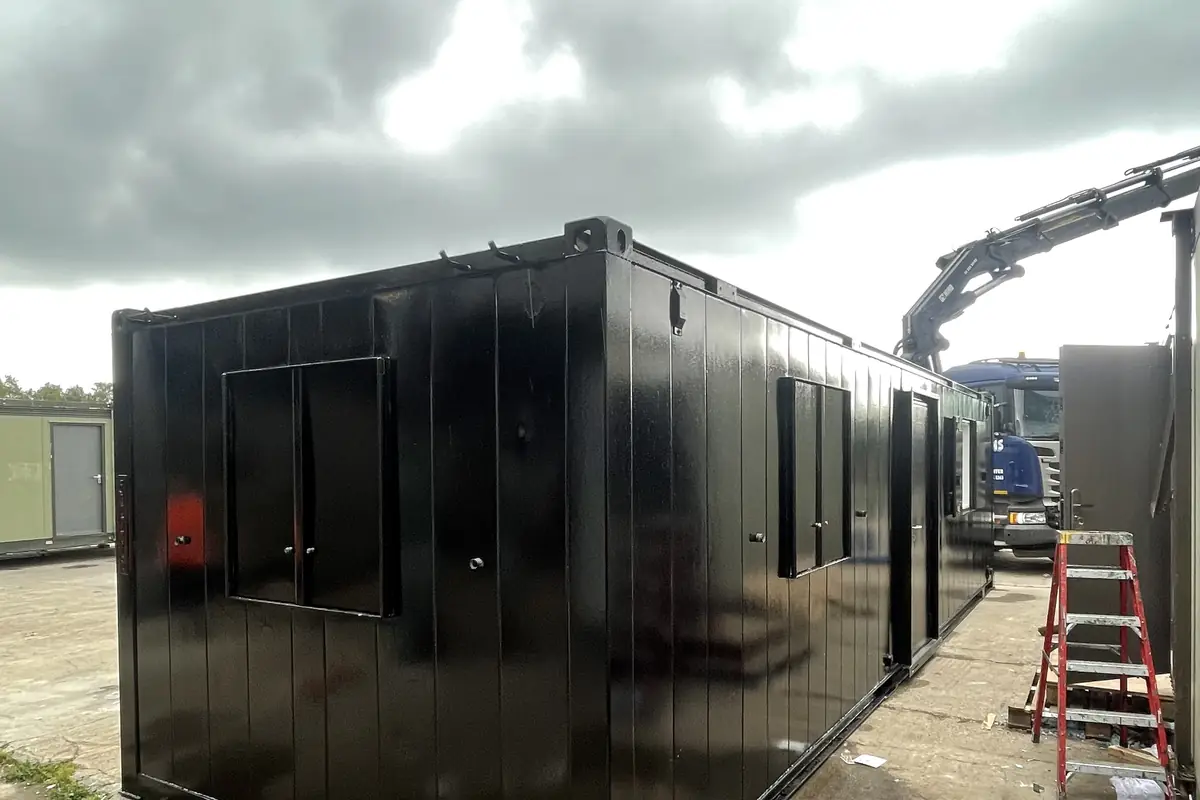
People ring us with the same sentence more often than any other: I have got a building I need rid of. Buried in it are two completely different jobs. One of them ends with money coming to you. The other ends with an invoice. The difference is not size, and it is not age either, whatever people assume.
What actually decides it
A used building is worth buying when somebody else can put it back to work without spending more than it is worth to get it there. That is the whole test. Everything else is detail feeding into it.
The detail that matters most is whether the building can be lifted and moved in one piece, or in the pieces it was designed to come apart into. A unit that comes off its base clean, sits on a bed and travels is a saleable thing. A building that has been extended, tied into brickwork, had a roof run over the join with the building next door, or had its sub-frame corroded to the point where lifting would tear it, is not a saleable thing at any price. It is a demolition with a tidy-up.
After that comes condition, and condition is narrower than people think. Scuffed walls, tired flooring, a door that binds, missing ceiling tiles, a wasp nest in the eaves: none of that stops a building being bought. What stops it is water. Water that has been getting in for a couple of winters through a failed roof or a cracked seal will have gone into the floor deck and the wall build-up, and by then you are not looking at a refurbishment, you are looking at a shell.
The three answers you can get
When we look at photographs of a building, one of three things is true.
- We buy it. The building has resale value, and that value is bigger than what it costs to get it out and back to Manchester. You get a figure for the building.
- We clear it. The building has no resale value, or so little that the transport swallows it. You get a figure for taking it away, which is a cost to you, and we say plainly that is what it is. That work is set out on modular building disposal.
- It nets out somewhere in the middle. This is the one people do not expect. On a mixed site, the good units carry the poor ones. Three sound bays and two write-offs can come off the same yard on the same visit, and the arithmetic is done across the lot rather than unit by unit.
That third answer is the reason we ask for the whole picture rather than the one building you are most worried about. Sending photographs of your worst unit and nothing else gets you the worst answer available.
Why age is a poor guide
A building from the early nineties that has been dry, used gently and kept painted is a better buy than something a decade newer that has stood empty on a wet corner with a flat roof full of leaves. We have bought buildings older than the people selling them and turned down units that were still being described as nearly new.
What age does change is the specification. Older stock is built to the standards of its day, and how a particular building performs thermally depends on its age and how it was originally put together. We describe the actual building in front of us rather than making a claim about a class of buildings.
The costs that sit on the other side
Whichever way the answer falls, the same physical job has to happen: something has to lift the building, something has to carry it, and it has to be able to get in and out. Access is the single biggest thing that moves the number, and it is the thing customers most often assume will be fine.
Overhead cables, a gateway that a rigid lorry cannot swing into, soft ground that will not carry a loaded vehicle with its outriggers down, a building sitting behind two others that have to come out first, a neighbour who will not have the vehicle across their frontage: any of those can turn a straightforward lift into a planned job. None of them are dealbreakers on their own. They just need to be known before anything is agreed rather than discovered by a driver at eight in the morning.
We quote the building and the haulage as two separate figures for exactly this reason. You can see what your building is worth, and you can see what moving it costs, instead of getting one number that hides which half is which.
What to send
Photographs from all four sides, one of the interior looking down the length, one of the roof if you can get above it safely, and one taken from the gate looking towards the building so we can see the run in. Rough dimensions. The postcode. An honest word about anything you already know is wrong with it.
That is enough for a figure on most buildings, normally the same working day. Bigger modular blocks, and anything where what it is made of needs establishing first, need eyes on site before anything is agreed, and we will say so rather than quoting blind and revising later.
If you are not sure which of the two jobs you have, that is fine. Working it out is our end of it. Send the photographs and we will tell you which side of the line your building falls on, including when the answer is one you would rather not hear.