
Used modular buildings for sale
Second hand modular buildings for sale across England, Scotland and Wales. Factory-built bays that bolt together on site to make one larger building. We buy them from schools, hospital estates, local authorities and contractors, refurbish what is worth refurbishing, and deliver on our own transport.
The basics
What modular actually means
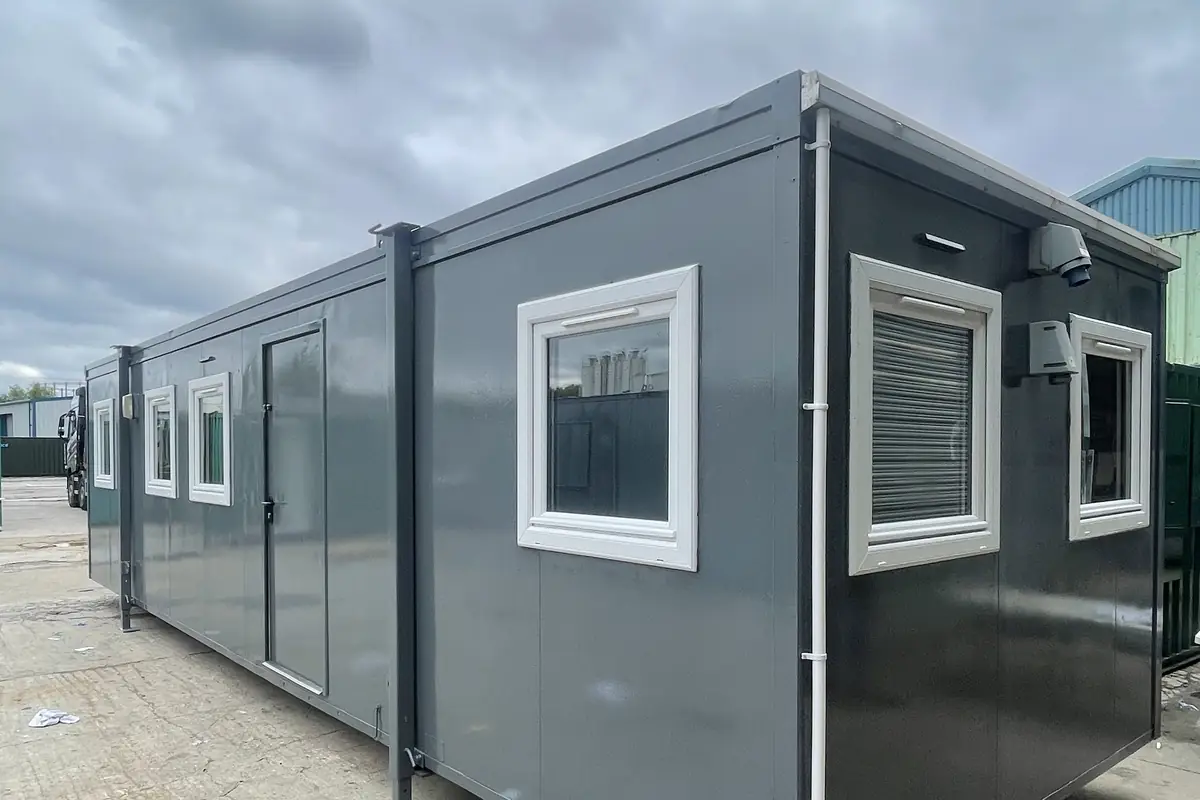
A modular building is not one thing lifted off a lorry. It is a set of sections — bays — each built in a factory, transported separately, and joined on site along their long edges. The join is the whole trick. Bays are pulled together with structural fixings, the roof and floor junctions are sealed, and the internal linings are made good across the seam so the finished space reads as one room rather than several.
That construction is why modular suits anything needing width. A single portable unit is limited by what a lorry can legally carry. A modular block is limited only by how many bays you can afford to land and how much ground you have to land them on. Open-plan offices, classrooms with proper circulation, canteens and treatment suites all come from the same principle.
It also means the unit can be taken apart the way it went together. A well-detailed modular block lifts back into bays and moves again, which is exactly why so much good second-hand stock exists.
Configurations
How bay count translates into a unit
Bay sizes vary by manufacturer and era, so treat the footprints below as the shape of the thing rather than a specification. Every unit we offer is measured and described individually.
| Configuration | Approximate footprint | Typical use |
|---|---|---|
| Single bay | Roughly 3m wide by 6m to 12m long | Site office, small classroom, consulting room, security or gate building. One lift, one delivery. |
| Two-bay | Roughly 6m wide by 9m to 12m long | Open-plan office for a small team, a full-size classroom, or an office and welfare split. |
| Four-bay | Roughly 12m wide by 12m long | Departmental office, twin classroom with shared circulation, canteen and messing block. |
| Six to eight bay | Roughly 12m to 18m wide by 12m to 18m long | Main site accommodation block, teaching block with corridor, clinic with several treatment rooms. |
| Multi-storey | Two levels over a matching ground footprint | Where the plot is tight. Needs an external stair or lift and a base designed for the loading. |
Ceiling heights, window positions and the presence of a corridor all change what a given footprint feels like to work in. If you tell us how many people need to sit in it, we can generally work backwards to the right block.
Installation
Three things that decide whether it lands cleanly
Modular buildings rarely go wrong in the factory. They go wrong on site, and nearly always for one of these three reasons.
Lifting and multiple lifts
Each bay is a separate lift. A four-bay block is four lifts, plus the roof capping and any external stair. The lifting vehicle needs firm standing, a clear swing radius and no cables overhead. Where the lifting vehicle can stand, and how far it has to reach, matters more than the weight of the bay itself.
Groundworks and a level base
Bays are joined along their length, so any twist in the base shows up immediately as a gap at the seam. Pads, a slab or engineered piers all work provided they are level and can carry the point loads. Ground that looks flat by eye is frequently not, and correcting it after the first bay has landed is expensive.
Services across the seam
Power, data, heating and drainage have to be linked between bays once they are joined. On a well-made unit the connections are designed in and marked up. On a poorly stripped one they were cut at removal. Ask which you are buying, because reinstating the links is real work.
We install with our own transport and arrange lifting to suit the site, so the delivery date is one we control rather than one we hope a haulier honours. Read more about how we run deliveries and collections on the nationwide collection page.
Condition and refurbishment
Most of the value is in what is fixable
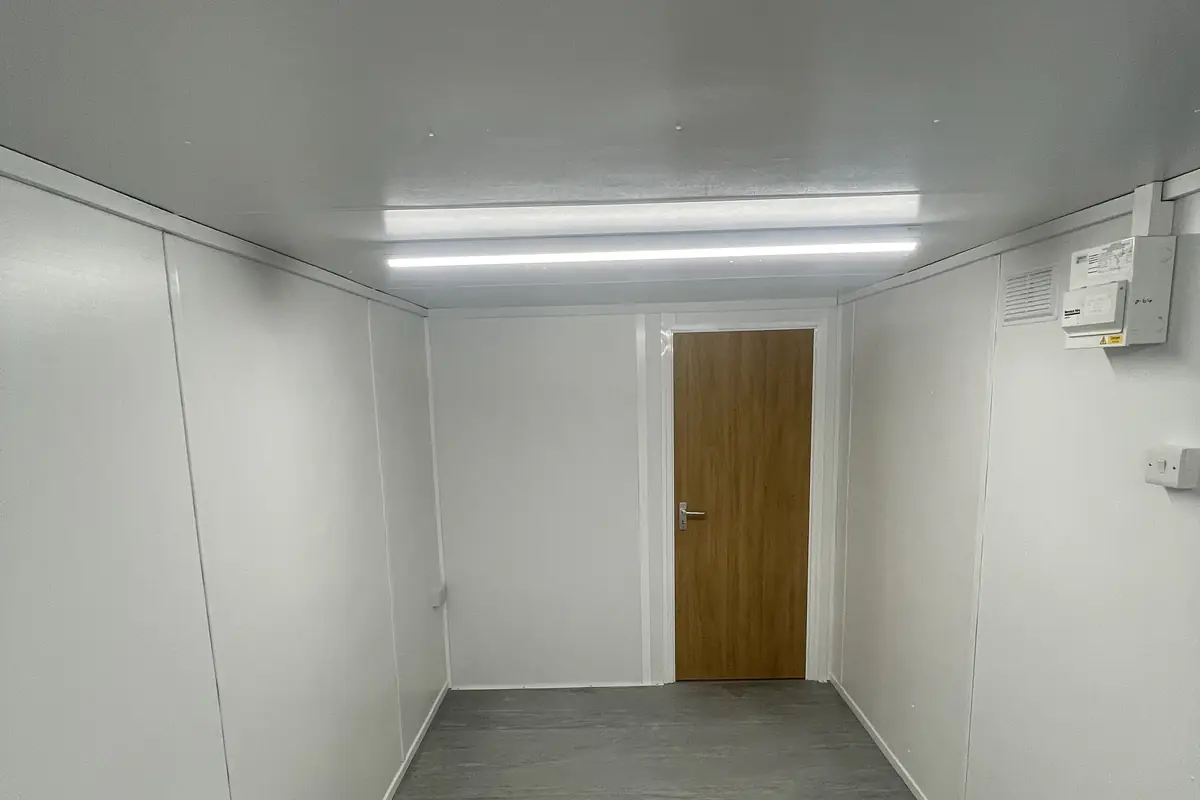
Used modular stock arrives in every state from nearly new to fit only for stripping. The structural frame, the floor deck and the roof are the parts that decide whether a unit is worth anything. Almost everything else — flooring, decoration, ironmongery, partition layout, even windows — can be put right in the yard for a fraction of what the same work costs once the unit is standing on your site.
- Worth asking about
- Bay count, overall footprint, ceiling height, whether the link detailing is intact, and whether it has been moved before.
- Structural checks
- Frame corners, floor deck for soft spots, roof for standing water and previous patching, and the condition of the lifting points.
- Refurbishment we carry out
- Done in our own yard: flooring, full redecoration, replacement doors and windows, revised partitions, new heating and lighting.
- Electrical work
- Carried out here as part of the refurbishment, and the majority of refurbished buildings are supplied with electrical certification.
- What we decline
- Set out plainly on the what we take page. Condition decides, not size.
Have a modular block of your own to move on, or one standing idle after a contract closed? We buy them. Start with selling a modular building or get a building valuation. Where a block is genuinely past saving, modular building disposal is the other route.
What are you looking for?
What is standing in the yard changes from week to week, so the useful conversation starts with what you need rather than with a list. Describe the size, the layout and where it is going, and we will tell you what we can supply, in what condition, and what the building and the transport each cost.
Have something to trade in? Tick the part exchange box. A building coming the other way usually improves the arithmetic in both directions.
- Two figures — the building and the haulage — so you can see what you are paying for
- Refurbishment to your specification before delivery is usually possible
- Part exchange welcome — a building coming the other way is part of the deal
Common questions
Used modular buildings, answered
How is a modular building different from a portable one?
A portable building is normally one self-contained unit that lifts and travels whole. A modular building is assembled from several factory-built bays that bolt together on site to form one larger space. That difference decides almost everything else: transport, lifting, groundworks and how long installation takes.
Can a used modular building be reconfigured?
Often, within limits. Internal partitions, door positions, flooring and finishes are routinely changed in the yard before delivery. What cannot easily change is the bay module itself, because the structural frame and the roof line are fixed at manufacture. Tell us the layout you want and we will say what is achievable.
How many bays can be joined together?
Multi-bay blocks of six, eight or more are common, and some sites run two storeys. The practical limits are your ground conditions, lifting access and the linking detail the original manufacturer used. Very large blocks are usually installed over several days rather than one, with bays landed in a planned sequence.
Do I need a lifting vehicle to install one?
Almost always, and usually more than one lift because each bay is placed separately. The lifting vehicle needs firm level standing, a clear radius and no overhead cables in the swing. Send photographs of the access and the intended position and we will tell you what plant the installation will need before anything is booked.
What sort of base does a modular building need?
A level, load-bearing base that suits the bay spacing. Concrete pads under the bearing points, a slab, or engineered piers are all used. What matters most is that the base is genuinely level, because bays that do not sit true will not link properly and the doors and windows will bind afterwards.
Where does your used modular stock come from?
Schools and academy trusts finishing a rebuilding programme, NHS estates, local authorities rationalising their sites, construction contractors closing out a project, and fleet operators refreshing their stock. That is why availability changes from week to week, and why it is worth telling us what you need rather than working from a list.
Tell us the size and layout you need
Bay count, floor area, how many people have to work in it and the postcode it is going to. That is enough for us to say what we can supply, and what the building and the transport each cost.